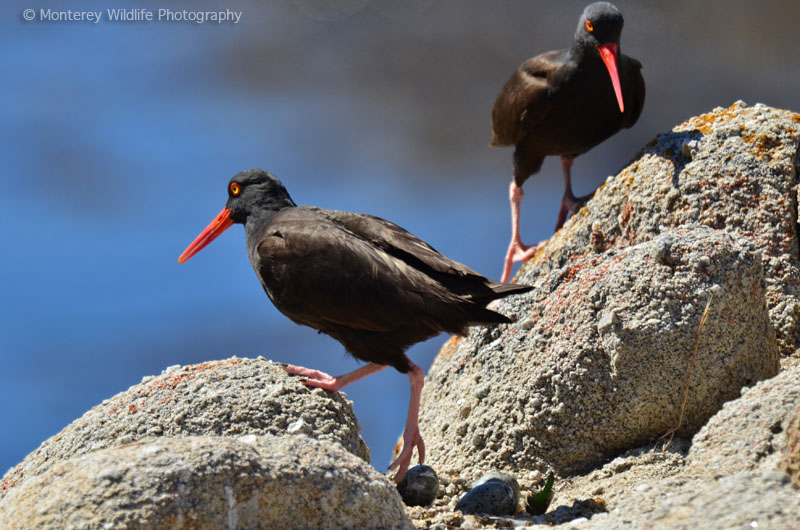
Every day when we are out walking along the Monterey Bay shore, it is likely that we will see Black Oystercatchers - or rather we can hear them coming and going first and then locate them blending into the dark colored sea grass covered rocks. Once you get accustomed to their call, it is quite unmistakable. A few days ago, a friend observed some nest building activity - a collection of pebbles and other "found objects" which may be used to disguise the eggs. Knowing the location, and finding the sun burning through the typical marine layer, we cautiously approached the nest site.
We immediately saw one of the Black Oystercatchers perched on the rocks where they often spend the afternoon soaking up the sun. Even the arrival of the second one wasn't unusual as they are often seen in pairs. The second Oystercatcher was out of this shot on the rocks above.
We saw the second Oystercatcher approaching from the right. The birds were communicating somehow but not with their usual high-pitched chatter.
We were then treated to the sharing of the nesting duties, as both the male and female take turns brooding of the eggs. We watched and photographed the pair as they exchanged positions. While this took place, we observed three eggs and some of their found object "nesting material".
The nesting exchange took place as shown in the following sequence of shots. I would guess that the eggs were exposed for less than 10 seconds. The Nikon D7000 with the effective 600mm lens captured the scene at about 6 frames per second. Some of these shots have been moderately cropped and sharpened.
With this shot, the exchange is complete and the second bird is carrying on the nesting duties.
During another exchange later in the afternoon, we were fortunate to get this shot of both the male and female birds and the exposed eggs. There is certainly some communication going on here - maybe it is one telling the other to get on the eggs fast. You can see that the eggs are quite exposed and there are always predators lurking along the ocean.
This second egg nesting exchange was also quickly accomplished.
And finally, we left the pair with one gone off in the search for food while the other struck one final nice pose. We will return often to see how the nesting is going. We read that the mortality rate of Black Oystercatcher chicks is very high. We certainly hope that some of this brood will make it.
We often find that the Washington State Audubon Society has some of the better information to be found on the web. The information
here about the Black Oystercatcher is the best summary information we have found after looking at several books and many web sites. There is good nesting habitat information that describes the gestation period and how the parents bring the young food for several weeks after hatching.
Wikipedia also has excellent information on the Black Oystercatcher
here.
We also found that California eBird held a Black Oystercatcher survey just a month ago. We missed it unfortunately but we have our own observations that help complete the local history for us. California eBird information can be found
here.
We also would like to add our own clarifications about the Black Oystercatchers we see here in the Monterey Bay area. We frequently read that these birds are black - as you see here and in many other shots we have taken, particularly those in good sunlight, these birds have a black head but the main body color is dark brown.
With luck, we will be able to watch this nesting pair for weeks to come. Stay tuned.